
Science

Biological Computationalism Offers New Perspective on Consciousness
The debate about consciousness is often polarized between computational functionalism and biological naturalism. However, a new concept, biological computationalism, proposes a third path to understanding consciousness. This idea suggests that computation in the brain is unique and cannot be fully explained by traditional computational paradigms. Biological computationalism has three defining properties: it is hybrid, combining discrete events with continuous dynamics; scale-inseparable, with no clear distinction between software and hardware; and metabolically grounded, with energy constraints shaping computation. This perspective implies that consciousness depends on computation deeply integrated with physical and energetic constraints. As a result, replicating mind-like cognition may require new physical systems beyond conventional digital architectures. The brain's computation is not just a matter of abstract symbol manipulation, but an intrinsic property of the system itself, shaped by its physical organization and energetic constraints. This challenges the current approach to artificial intelligence, which focuses on improving algorithms rather than the underlying computational ontology. Biological computationalism demands a shift from searching for the right program to searching for the right kind of computing matter, one that is hybrid, scale-inseparable, and energetically grounded.
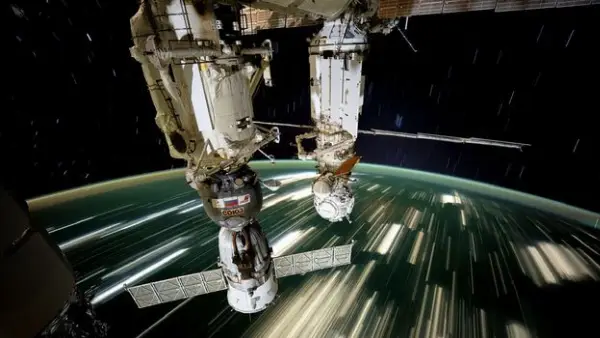
International Space Station Celebrates 25 Years in Orbit
The International Space Station (ISS) has been in orbit for 25 years, representing one of humanity's most ambitious engineering projects. Since the first Expedition 1 mission, over 280 astronauts and cosmonauts have visited the ISS, with the station being continuously occupied. The ISS demonstrates international cooperation and has led to numerous breakthroughs in space research. Some notable facts about the ISS include its 27-year-old oldest module, 388 cubic meters of habitable volume, and 98% water recycling rate. Astronauts spend two hours a day exercising to combat the effects of weightlessness, and the station has hosted various musical performances, including a didgeridoo made from a vacuum cleaner. The ISS has also been the site of significant scientific research, with over 4,400 research papers published. As the station continues to operate, it has become a symbol of what can be achieved through international collaboration and innovation. With a total cost estimated at $150 billion, the ISS is a remarkable feat of engineering and a testament to human ingenuity.
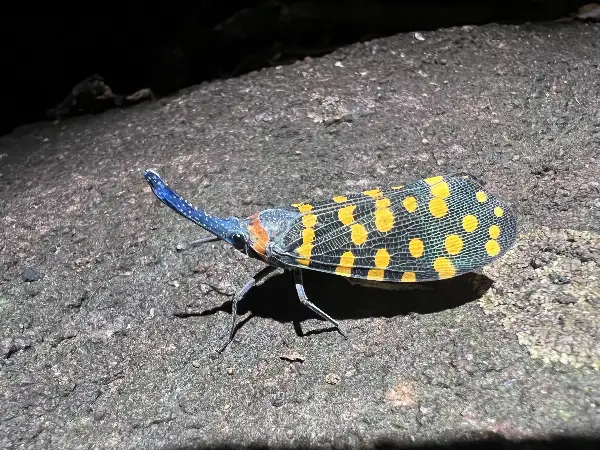
New Species Discovery Reaches All-Time High, With Over 16,000 Species Described Annually
A new University of Arizona-led study published in Science Advances reveals that scientists are discovering new species at a faster rate than ever before, with over 16,000 new species described every year. The study analyzed the taxonomic histories of roughly 2 million species and found that between 2015 and 2020, researchers documented an average of more than 16,000 new species each year. This includes over 10,000 animals, 2,500 plants, and 2,000 fungi. The team projects that there may be as many as 115,000 fish species and 41,000 amphibian species, despite only about 42,000 fish and 9,000 amphibian species being described so far. The discovery of new species is crucial for conservation and can also lead to the discovery of new natural products with potential medicinal applications. The researchers plan to map where most new species are commonly found to identify geographic hotspots for undiscovered biodiversity. With advances in molecular tools, the team expects to uncover even more cryptic species, highlighting the vast, still-unknown biodiversity of our planet.

Scientists Unlock Secrets of 1.4 Billion-Year-Old Air in Ancient Salt Crystals
A team of researchers from Rensselaer Polytechnic Institute, led by graduate student Justin Park and guided by Professor Morgan Schaller, has analyzed the composition of gases and fluids trapped in 1.4 billion-year-old halite crystals from northern Ontario. The crystals, formed when a subtropical lake evaporated, contain air bubbles that reveal the composition of the early Earth's atmosphere. The findings, published in the Proceedings of the National Academy of Sciences, show that the Mesoproterozoic atmosphere contained 3.7% as much oxygen as today's atmosphere and ten times more carbon dioxide. These levels suggest a milder, modern-like climate, challenging previous assumptions about this era. The high oxygen levels are surprising, as they would have been sufficient to support complex multicellular life, which did not evolve until hundreds of millions of years later. The researchers believe that the sample may capture a brief, transient oxygenation event in the "boring billion" era, a period of low oxygen levels and scant evolutionary change. The discovery provides new insights into Earth's evolutionary history and the development of its atmosphere. The team's direct measurements of high carbon dioxide levels and temperature estimates from the salt suggest that the Mesoproterozoic climate was comparable to today's. The findings also highlight the importance of red algae, which arose during this period and remain a significant contributor to global oxygen production today. The research has significant implications for our understanding of how complex life arose on Earth and how the atmosphere came to be what it is today. The study demonstrates the value of analyzing ancient salt crystals to unlock secrets of the past and provides a new perspective on the Earth's history. The team's work has shed new light on the Mesoproterozoic era, a period that was previously poorly understood. The discovery of high oxygen levels and a milder climate challenges previous assumptions and provides new insights into the evolution of life on Earth. The research was made possible by custom equipment built in the lab of Professor Schaller, which allowed the team to accurately measure the gases trapped in the halite crystals. The findings have been peer-reviewed and published in a reputable scientific journal, ensuring the credibility and accuracy of the research.
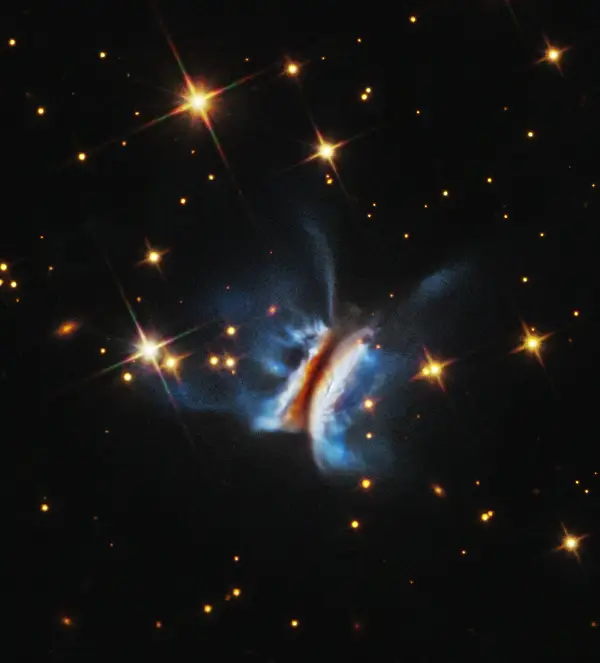
Hubble Reveals Largest Known Protoplanetary Disk, "Dracula's Chivito"
Astronomers using NASA's Hubble Space Telescope have imaged the largest protoplanetary disk ever observed, nicknamed "Dracula's Chivito" (IRAS 23077+6707). The disk spans nearly 400 billion miles, approximately 40 times the diameter of our solar system, and is located about 1,000 light-years from Earth. The Hubble images reveal the disk to be unexpectedly chaotic and turbulent, with bright wisps of material extending far above and below the disk. Notably, these filament-like features are only visible on one side of the disk, suggesting dynamic processes are shaping the disk. The disk is estimated to contain 10 to 30 times the mass of Jupiter, making it an exceptional case for studying the birth of planetary systems. According to lead author Kristina Monsch, "The level of detail we're seeing is rare in protoplanetary disk imaging, and these new Hubble images show that planet nurseries can be much more active and chaotic than we expected." The discovery offers fresh insights into planet formation in extreme environments and marks a new milestone for Hubble. The findings were published in The Astrophysical Journal, providing a unique laboratory for studying planet formation and the environments where it happens. The nickname "Dracula's Chivito" reflects the heritage of the researchers, with one from Transylvania and another from Uruguay. The edge-on disk resembles a hamburger, with a dark central lane flanked by glowing top and bottom layers of dust and gas. The new images and data from Hubble will help scientists better understand how planets form in different environments and the underlying processes involved. As co-investigator Joshua Bennett Lovell noted, "Hubble has given us a front row seat to the chaotic processes that are shaping disks as they build new planets—processes that we don't yet fully understand but can now study in a whole new way."
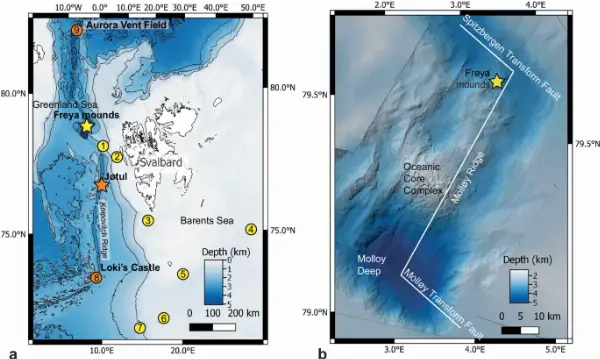
Deep-Sea Gas Hydrate Mounds and Chemosynthetic Fauna Discovered at 3640m on the Molloy Ridge, Greenland Sea
Researchers have discovered deep-sea gas hydrate mounds and chemosynthetic fauna at a depth of 3640 meters on the Molloy Ridge in the Greenland Sea. The mounds, named the Freya gas hydrate mounds, are the deepest known hydrate deposits worldwide and are inhabited by a diverse range of species, including siboglinid and maldanid tubeworms, skeneid and rissoid snails, and melitid amphipods. The discovery was made during the Ocean Census Arctic Deep – EXTREME24 expedition, which used a remotely operated vehicle (ROV) to explore the seafloor and collect samples. The findings provide insights into the geology and ecology of these habitats and their regional context for understanding patterns of deep-sea biodiversity in the Arctic. The Freya gas hydrate mounds are located on the Molloy Ridge, a slow to ultraslow spreading centre in the Fram Strait. The mounds are conical in shape, approximately 4-6 meters in diameter, and 2-4 meters high. They are covered by a thin layer of soft sediment and are colonized by dense aggregations of siboglinid polychaetes. The mounds are also inhabited by other species, including maldanid polychaetes, melitid amphipods, and skeneid and rissoid snails. The discovery of the Freya gas hydrate mounds and their associated fauna highlights the need to understand the composition and distribution of species and deep-sea habitats across this region. The findings also have implications for the management of deep-sea mining activities in the Arctic, which could potentially impact these unique ecosystems. Further research is needed to fully understand the ecology and biogeography of these habitats and to develop effective conservation strategies. The study also found that the fauna at the Freya mounds shows a high degree of similarity with the fauna at the Jøtul vent field, which is located at a similar depth. This suggests that there may be a connection between the two habitats, and that species may be able to disperse between them. The study also found that the fauna at the Freya mounds is distinct from that found at shallower depths, and that depth may be an important factor in determining the composition of deep-sea communities. Overall, the discovery of the Freya gas hydrate mounds and their associated fauna provides new insights into the diversity and complexity of deep-sea ecosystems in the Arctic. Further research is needed to fully understand these ecosystems and to develop effective conservation strategies to protect them.
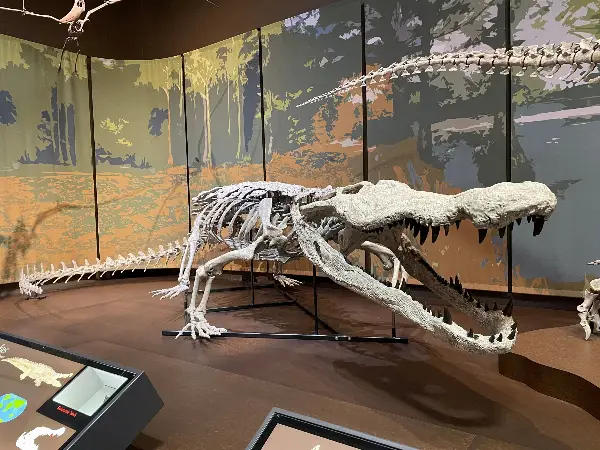
First Scholarly Accurate Fossil Replica of 'Dinosaur-Killer' Croc Created
A decades-long quest has led to the creation of the first scholarly accurate fossil replica of Deinosuchus schwimmeri, a giant Late Cretaceous crocodilian and apex predator. The replica, installed at the Tellus Science Museum in Cartersville, Georgia, is the result of a two-year project involving Dr. David Schwimmer, a Columbus State University geology professor, and Triebold Paleontology Inc. Deinosuchus schwimmeri, which lived 83 million to 76 million years ago, was a dinosaur-eating, school-bus-sized relative of modern alligators, measuring up to 31 feet long. The replica is based on high-resolution 3D scans of Deinosuchus fossil records and provides a detailed picture of the creature's anatomy and ecological role in prehistoric southeastern U.S. ecosystems. The creation of the replica is a significant milestone in the field of paleontology, as it allows for a better understanding of the species' predatory habits and survival strategies. Dr. Schwimmer's research on Deinosuchus has spanned over 40 years, and his work has led to the discovery of evidence for specific "firsts" in Georgia, including flying reptiles, dinosaurs, and Deinosuchus. The replica is expected to provide a unique educational experience for visitors to the Tellus Science Museum, allowing them to visualize the scale and scope of the creature in a way that is not possible through words or pictures alone.
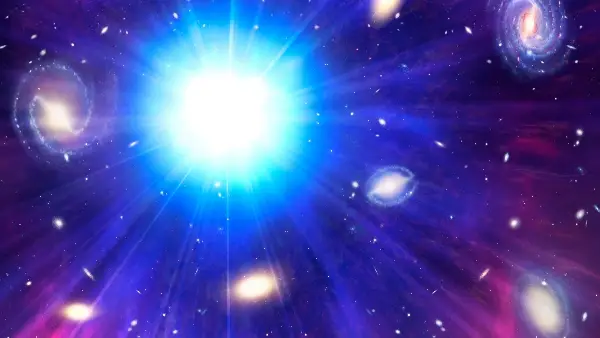
Study Suggests the Universe May Be Asymmetric, Challenging Standard Cosmological Model
The shape of the Universe is typically assumed to be isotropic, or the same in all directions, and homogeneous on large scales. However, a new study suggests that the Universe may be asymmetric or lopsided, posing a challenge to the standard cosmological model. This model, also known as the Lambda-CDM model, is based on the assumption of a uniform Universe. The study focuses on the cosmic dipole anomaly, a variation in the cosmic microwave background (CMB) radiation that is not matched by corresponding variations in other astronomical data. The CMB is uniform over the sky to within one part in a hundred thousand, but it does exhibit a dipole anisotropy, with one side of the sky being hotter and the opposite side being cooler. The Ellis-Baldwin test, which compares the variation in the CMB to the variation in distant astronomical sources, was used to investigate this anomaly. The results show that the matter and CMB dipoles do not match up, with the directions being consistent but the amplitudes not. This discrepancy challenges the standard cosmological model and may require abandoning the Lambda-CDM model and the FLRW description of spacetime. The astronomical community has largely ignored the cosmic dipole anomaly, possibly because there is no easy way to resolve the issue. However, new data from upcoming satellites and telescopes may provide insights into constructing a new cosmological model, potentially harnessing advances in machine learning. The impact of such a breakthrough would be significant, challenging our understanding of the Universe and fundamental physics.
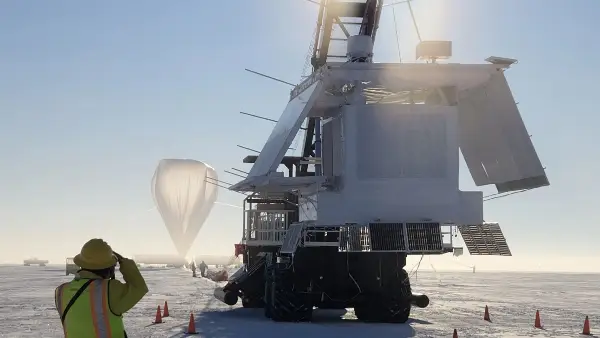
NASA Launches Scientific Balloon from Antarctica to Study Antimatter and Dark Matter
NASA has launched its first scientific balloon of the 2025 Antarctica Balloon Campaign, carrying an experiment called GAPS, the General AntiParticle Spectrometer. The balloon lifted off from the agency's Antarctic facility on December 16 and reached a float altitude of about 120,000 feet, high in the stratosphere. The GAPS instrument aims to detect rare particles from space, including antimatter nuclei such as antideuterons, antiprotons, and antihelium. If successful, the detection of these particles could provide important clues about dark matter, a mysterious substance that makes up most of the universe but is invisible to us. The balloon campaign operates from a site on the Ross Ice Shelf near the U.S. National Science Foundation's McMurdo Station, taking advantage of the near-constant sunlight and stable polar wind patterns during the austral summer. This allows the payloads to gather data for days to weeks as they circle the continent. The GAPS experiment uses a time-of-flight system and a tracker system to measure and record the interaction of particles. The project is expected to reveal more about the universe and the mysterious substance of dark matter. Antarctica is one of the best places on Earth to fly these missions due to its unique conditions, and NASA's annual Antarctic Long-Duration Balloon campaign has been operating from the site for years. The success of this mission could lead to significant breakthroughs in our understanding of the universe and its composition.
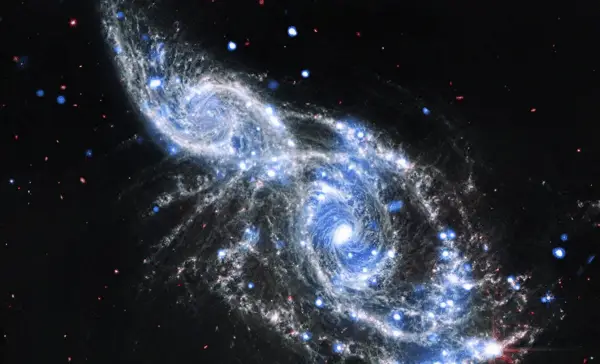
James Webb Space Telescope Captures Dazzling Image of Ancient Galaxy Cluster
The James Webb Space Telescope (JWST) has released a stunning new image of a dense cluster of galaxies, showcasing a complex web of glittering galaxies, shimmering stars, and chaotic filaments. The image, captured by the JWST's Near-Infrared Camera (NIRCam), represents light that has traveled for over 13 billion years, dating back to a time shortly after the Big Bang. This region, located in the constellation Sculptor, demonstrates how matter in the universe organizes itself under the influence of gravity. The JWST's sensitivity allows researchers to observe these processes at an unprecedented scale, capturing faint glimmers of starlight that older telescopes could not detect. The James Webb Telescope operates primarily in the infrared spectrum, enabling it to see through dense cosmic dust that obscures visible light. This capability reveals the inner workings of stellar nurseries, where new stars are born. Infrared imaging also helps astronomers measure the redshift of galaxies, estimating distances and ages, and reconstructing a three-dimensional timeline of cosmic evolution. The image represents both mature galaxies and nascent clusters still in formation, with the glittering points of light showcasing the universe's structure. The phrase "cosmic web" is a literal map of the universe's structure, with galaxies forming vast networks connected by filaments of dark matter and intergalactic gas. Researchers are now analyzing this Webb data to better understand how dark energy and dark matter influence the growth of these structures. By studying the intricate geometry of the web, astronomers hope to answer fundamental questions about the universe's structure and evolution.